Presented by Nuit Blanche with the support of FADO and many collaborators.
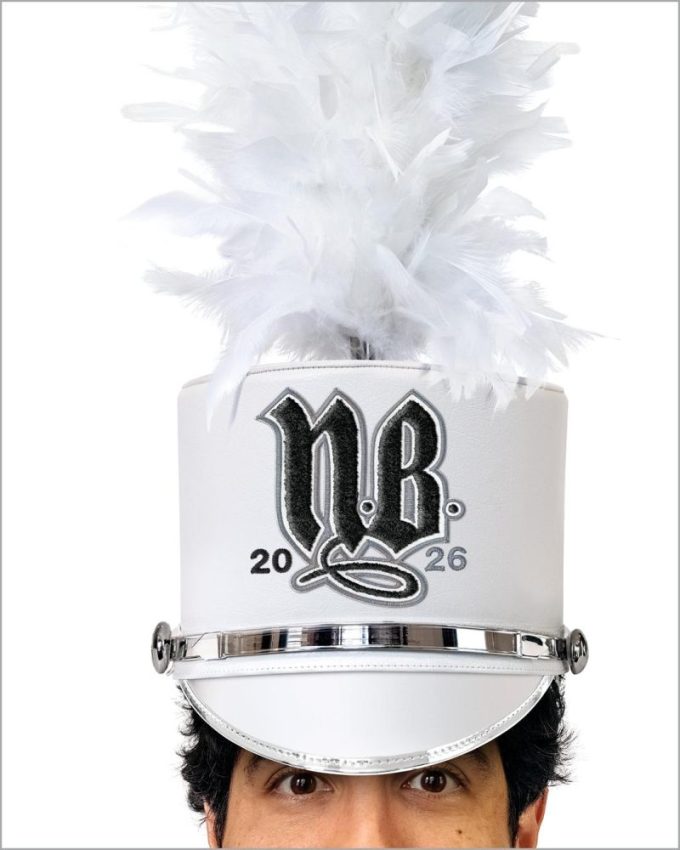
A marching band of marching bands, with players of all ages, including professional musicians and talented enthusiasts from across Toronto, will form for one night only to chime in the thirteen hours of Nuit Blanche. The 2026 Nuit creative campaign, designed especially for the 20th anniversary by Lisa Kiss, will come to life on the ramp at City Hall as bands appear every hour on the hour to ring in the time.
Led by Keith Cole, performance artist and drum major extraordinaire, and costumed by local fashion hero Susan Dicks, this super band – led by Nolan Murphy – will process across Nathan Philips Square in grand style. This will be a band band to remember!
Concept and Design: Lisa Kiss Producers: Naomi Campbell, Caroline Hollway Band Leader: Nolan Murphy/SHOUT! Drum Major: Keith Cole Costumes: Susan Dicks Photography: Henry Chan Video: Peppercorn Imagine Studio
This year’s theme – Tomorrow’s Memories – looks back to the artists, curators, communities and places that defined Nuit Blanche and hold its histories. But this is not just about the past, it’s a way to look at the present and a provocation for the future. Past Nuit Blanche artworks will be revisited, re-visioned and recontextualized while artists can also create new works that consider personal and collective memory and histories as a tool for storytelling, reflection and dreaming of possible futures. Projects may also explore ideas around memory itself, nostalgia and ephemerality.
This milestone edition offers both a reckoning and a reimagining, reflecting on not only where it has been, but on where it is now and where it might be going next.
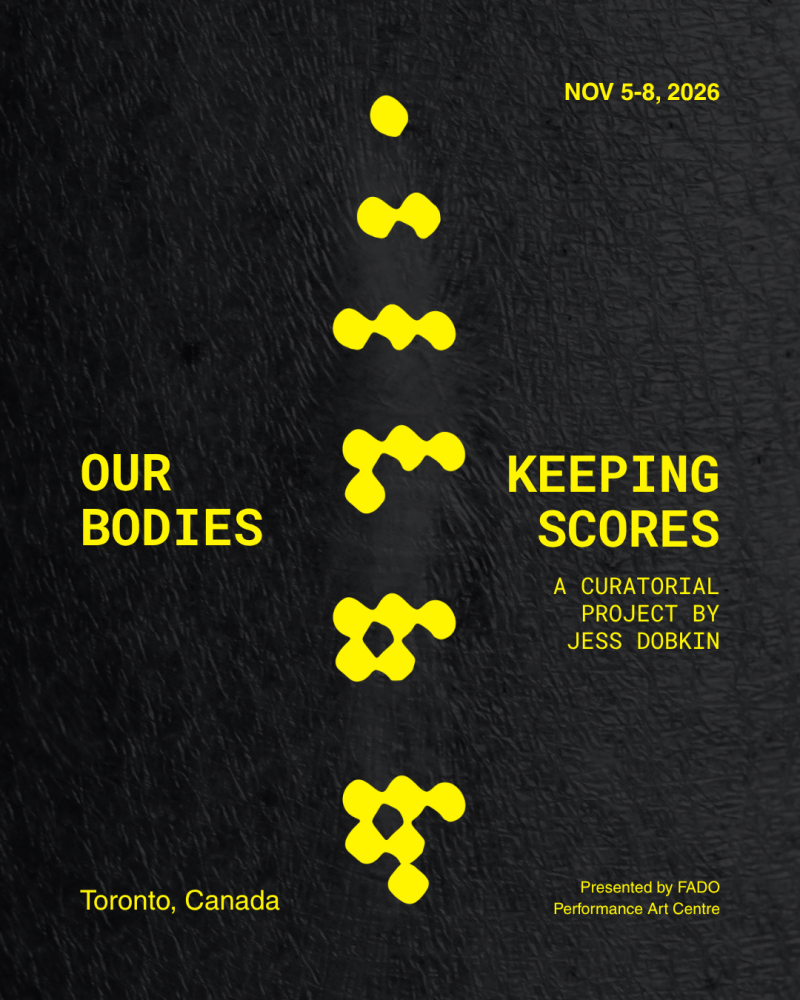
A curatorial project by Jess Dobkin Presented by FADO Performance Art Centre
With collaboration and support from Hemispheric Encounters: Developing Transborder Research-Creation Practices, York University, and the Queer and Trans Research Lab, Mark S. Bonham Centre for Sexual Diversity Studies, University of Toronto and OCADU University.
ARTISTS Germaine Liu (Toronto, CA) Juma Pariri (Abya Yala/São Paulo, Brazil) Juru (Fortaleza, Brazil) Karen Finley (New York, USA) Leslie Ting (Toronto, CA) María de Lourdes Santana Arcos (Havana, Cuba) n:u (melissandre varin) (Benin/Birmingham, UK) Sara Baron-Goodman (Toronto, CA) Tamar Carter-King (Toronto, CA) Twysted Miyake-Mugler (Toronto, CA)
Curatorial Impulse
I’m thinking about our bodies: singular, plural, collective, communal, human, and other-worldly; with abandon and abandoned, in power and empowered, possessed and self-possessed, exalting and exalted. Political, primal, passionate. This program of artists reaches into and beyond conversations of trauma carried in the body to explore embodied scores that run parallel and perpendicular to wounding, and to perform the archives of our physical, personal, political, and transcendental bodies. Bodies on the line, bodies transgressing boundaries, bodies keeping scores.
It is also an opportunity for local and international artists to meet, to encounter each other’s work, and to meet Toronto audiences. You are warmly invited to join us in spaces of gathering, sharing, and experimentation with artists, curators, activists, musicians, dancers, scholars, students, and seekers. Together, in our vessels and vibrations, we take shape and shapes.
I look forward to welcoming you.
Jess Dobkin
PROGRAM
Thursday, November 5 Enoch Turner Schoolhouse, 106 Trinity Street (map) FREE | Wheelchair accessible | ASL interpretation
Doors 6:30PM | Performances 7:00PM
Performances: Juma Pariri, María de Lourdes Santana Arcos, n:u (melissandre varin) Food Activation: Sara Baron-Goodman Music-Composition: Germaine Liu
Friday, November 6 OCADU University, Room 190, 100 McCaul Street (map) FREE | Wheelchair accessible
Performance: 7:30PM Followed by talkback with Karen Finley & Jess Dobkin
Performance: Believe by Karen Finley Music-Composition: Leslie Ting Food Activation: Sara Baron-Goodman
Finley’s creates a series of artworks illustrating mentors and artists who “believed” in Finley and gave support. These supportive individuals had encounters with Finley–professionally, as friends, as teachers, worked with, met, taught, or collaborated with Finley. There are over a hundred drawings illustrating her story that are projected onto a screen cinematically.
On stage, Finley sits at a table handling the artwork she created that tells the narrative while a live camera with a bird’s eye view projects Finley’s hands and artwork onto the screen simultaneously in real time. While the images are projected, Finley tells the story of each “believe” encounter. The artworks act as a storyboard creating intimacy, the private made public of supportive relationships. The artwork is projected onto the screen. Some of the artists: Louise Bourgeois, Kathy Acker, Danitra Vance, bell hooks, Sinead O’Connor, Linda Montano, Joan Rivers, David Wojnarowicz, amongst others.
Finley will end the performance with a dramatic reading.
Saturday, November 7 The Commons @ 401, 4th floor, 401 Richmond Street West (map) FREE | Wheelchair accessible
12:30PM Screening: This is Ballroom by Juru and Vitã Followed by conversation with Juru, Twysted Miyake-Mugler, Mother Tamar Miyake-Mugler Limited capacity | RSVP required
4:00PM Creatives Anonymous with Karen Finley Creatives Anonymous is a 13-step program that is part sardonic yet serious that is influenced by 12-step programs except that we are not approved or part of a traditional self help group. Join us and share your creative issues!
Sunday, November 8 The Commons @ 401, 4th floor, 401 Richmond Street West FREE | Wheelchair accessible
POOLBODY is a new multi-site performance series unfolding across Toronto from August 6–9. Pools are complex spaces—sites of leisure and competition, public gathering and private escape, play and surveillance, intimacy, memory, access, exclusion, and joy.
POOLBODY brings together performances, conversations, workshops, and site-responsive projects that move through these tensions. Featuring Aisha Sasha John, Aysia Tse & (H)annah Kryworuchko, Hannah Palmer, Mikiki, Nyda Kwasowsky, Ranganathan Rajan, and Tess Martens. PLUS, a Seniors Movement Workshop with Roxy Menzies, and a Kids Pool Art Exhibit & watercolour workshop with Richa Baghel.
This series is made possible with support from Toronto Arts Council | Toronto Arts Foundation – Arts in the Parks, FADO Performance Art Centre and Dancemakers Curators in Community Fund.
PROGRAM – all events are FREE and OPEN to all
THURSDAY, AUGUST 6 (1) FADO Performance Art Centre, The Commons, 401 Richmond St. W. (MAP)
6:00 PM: Performance Lecture & Opening Reception Pool Maintenance by Hannah S. Palmer
FRIDAY, AUGUST 7 (2) Flagstaff Park, 42 Mercury Rd, Rexdale (ACCESS INFO & MAP)
12:30–1:30 PM: Kids’ Pool Art Exhibition & Kid’s Watercolour Workshop with Richa Baghel 1:00–2:00 PM: Seniors’ Movement Workshop led by Roxy Menzies
2:30–4:00 PM: Performances Lifelines (a pilgrimage with, to and for the waters) by Nyda Kwasowsky Phantasmagoria by Ranganathan Rajan PAPER. BAG. SAG. DOLL… by Tess Martens
SATURDAY, AUGUST 8 (3) Hart House Pool, University of Toronto, 7 Hart House Circle (ACCESS INFO & MAP)
6:30–8:30 PM: Performances pool notes and (mis)alignments by Aysia Tse & (H)annah Kryworuchko SPLASH PAD by Mikiki
SUNDAY, AUGUST 9 (4) Private Pool (please contact shalonwh@gmail.com for more information)
6:00 PM: Performance my astonishing wealth by Aisha Sasha John
ACCESS INFORMATION
(1) The Commons @ 401 has a barrier-free entrance on the northeast side of the building, with an automatic door. The Commons is on the fourth floor and can be reached by elevator. Accessible washrooms are available on the first and fourth floors.
(2) Flagstaff Park and pool deck is wheelchair accessible. Some activities will take place on grass, which may be uneven or difficult to navigate with a mobility device. The pool washroom has one step at the entrance and is not fully wheelchair accessible. ASL interpretation will be available for the seniors’ movement workshop and the pool performances.
(3) Hart House Aquatic Centre has barrier-free entrances and an elevator that serves all floors. The pool is on the lower level. A universal washroom is available on the basement level, near the Arbor Room. On weekends, visitors using the barrier-free entrance should enter from Tower Road. ASL interpretation will be available for the performance.
(4) Baby Point Road location is a private home and backyard pool. Unfortunately, the venue is not wheelchair accessible.
For access questions or to request additional accommodations, please contact Shalon at shalonwh@gmail.com
Co-presented by Alleyway Gallery and FADO Performance Art Centre
Friday, May 22 | 6:30pm Dermot Wilson Fan Wu Gwen MacGregor Quan Steele Marilyn Yogarajah
Saturday, May 23 | 3:00pm Christopher Petersen Isaak Fong Johannes Zits lo bil lwrds duniam
Prism of Fire performance series, curated by Johannes Zits, features 10 artists offering distinct responses to this fractured landscape against the backdrop of the city.
Positioned in a downtown laneway, the billboard Through the Prism of a Fire pulls a distant, damaged landscape into sharp focus. This large-scale image of a wildfire’s aftermath, clear-cut terrain swept into devastation, becomes the anchor for a series of performances in the final stretch of the CONTACT Festival in May.
Through forms such as spoken word, sound, fleeting installations, and subtle gestures, the artists stage live conversations between the scorched forest and the urban space that holds it. Working with the laneway’s acoustics, interruptions, and constraints, each artist initiates their own brief bridge between altered forest and public life. Together, these actions reimagine the billboard as a site of exchange where memory, place, and embodied presence meet in the tense space between destruction and renewal.
Through the Prism of a Fire reflects on the growing intensity of wildfires across Canada, capturing the aftermath of a 2024 blaze in the Cariboo region of British Columbia, on Lhtako Dene Nation territory. While fire is a natural part of the forest’s life cycle, increased and sustained human activity has disrupted this balance. Industrial logging, monocultures, and conventional forestry practices have stripped away the diversity and resilience that once allowed ecosystems to recover.
Join us for another instalment in FADO’s Walk-And-Talk performance series.
Free, all welcome.
Clint Enns takes us on a cinematic Walk-And-Talk through the work of Karl Grune’s 1923 film, Die Strasse, narrating the film as a performative-intervention.
Enns’ Die Strasse [Back Alley Edit] re-imagines Karl Grune’s 1923 Die Strasse as a walking film. The film follows movements of a man who leaves his home and drifts through the city at night, each step carrying him deeper into the dangers of the street. Cinema as walk, narrative as restless wandering.
The artist’s reworking intervenes in this walk by adding a textual element and voice, shifting the film from “silent walkie” to “talkie.” A detour[nement] where new stories emerge in motion.
Clint Enns is a visual artist, writer, and curator living in Tiohtià:ke / Montréal. His post-cinematic practice consists of reworking existing films, disrupting their conventional narratives and forms. His interventions destabilize the cinematic image, turning familiar works into sites of critical play and reinterpretation. By appropriating and manipulating filmic material, Enns challenges the permanence of cinema as a fixed cultural object, presenting it as malleable, thinking though the ways moving images persist, mutate, and circulate in a post-cinematic landscape shaped by digital technologies and remix culture.
SILT: FRESHWATER is an evening of performance. Through a public open call, four artists are each provided with 15 minutes to present an action, event, performance. Silt was originally started for dance, movement, and performance artists; however, it is open to everyone regardless of artistic or personal identifications. The aim of SILT: FRESHWATER is to provide participants with an accessible low stakes stage for experimentation and expression.
On September 1st, FADO joins the Independent Artists’ Union (IAU) to march in the annual Labour Day parade—and we want YOU to come too!
Founded in 1984 by a small group of media artists, and spearheaded by Karl Beveridge and the late Carole Condé, the IAU played a transformative role in improving the working conditions of Canadian artists by championing fair compensation and a living wage. Though it was active for only five years, the influence of the IAU continues to shape how artistic labour is understood and valued in Canada today.
To read more about the IAU, please check the resources below.
“The Independent Artists’ Union (IAU), otherwise known as the IAU, transformed artists’ material conditions through their advocacy for a living wage for artists. Active from 1984 to 1989, the IAU began as a small group of media artists meeting in one another’s kitchens and backyards, and grew to 700 active members spread across Ontario at its height. Its advocacy work and interaction with other actors and institutions endure as an important moment in the development of Canada’s art scene and the understanding of artistic labour.” (Lauren Medeiros, Labour and Ontario’s Visual Arts Sector)
The arts are notorious for underpaying the people who work in them. While most people acknowledge the importance of culture, few know how little is spent on them. Most cultural workers subsidize the arts through their labour. A living culture needs a living wage. (Carole Condé & Karl Beveridge)
FADO recognizes there are many reasons in our world today to march, to protest, and to raise your voice. With this collective action on September 1st, FADO stands in solidarity with the rights of all workers. FADO’s goal is to encourage a revival of the meeting of our local artistic communities—the old guard and the new, artist-run and independent, groups and individuals, legacy and new momentum. A bit like it used to be, and perhaps how it can be again.
Some of the original members of the IAU have marched every year in the Labour Parade from the early 80s up to the 2019 parade. This year, FADO is joining in and encouraging a revival of the MARCH OF THE ARTISTS. Join us, ALL WELCOME!
IMPORTANT INFORMATION
Parade starts at 9:30am SHARP! Please arrive at 9:15am latest.
We will have signage/banners to distribute–bring only yourselves!
FADO + ARTISTS’ UNION march with OPSEU (Ontario Public Service Employees Union).
Parade route: Queen Street West from University Ave. to Dufferin St., south on Dufferin to the Canadian National Exhibition (CNE).
Participants will receive a wristband to enter the Exhibition for free at the parade’s conclusion. NOTE: you must arrive to the rally point at the start of the parade to receive a wristband.
NOTE 2: you do not have to walk the entire route with us – you are welcome to walk with us for as long or as little as you would like.
Rally point: East side of University Ave., just north of Queen St. W. — Look for the gathering of OPSEU members and we will be there.
(top) FADO + Independent Artists’ Union, Labour Day, Toronto, 2025. Photo Henry Chan. (middle) The Artists’ Union, Labour Day, Toronto 2006. (bottom) The Artists’ Union, Labour Day, Toronto 2017.
not knowing is the most intimate explores themes of collective and personal grief, and the ways in which we might connect through shared vulnerability. Inspired by the Buddhist koan, “not knowing is the most intimate,” the project embraces the uncertainty of our contemporary emotional landscapes, inviting both artists and audiences to move into the discomfort of uncharted waters.
While reading Vanessa Machado de Oliveira’s Hospicing Modernity, I was struck by the idea that domination often involves a deliberate denial of relationships and a suppression of the senses. Drawing on Dwayne Donald’s assertion that sensory atrophy is central to this process – disrupting traditional knowledge systems and relational connections—I began to consider how deeply this numbness has seeped into the fabric of modern life. What would it mean to counter this—to resist detachment—through intimacy and attunement? This question sits at the heart of this curatorial series, exploring how performance can reawaken connection through embodied presence and shared vulnerability in times of grief.
Bringing together artists whose work grapples with death, mourning, collective grief, climate anxiety, somatics, and rituals of healing, the series unfolds across live performances, an immersive book installation, a sound bath and guided meditation inspired by the tradition of living funerals. It is an experiment in shedding emotional armour – to feel, to connect, to soften. It is an invitation to let grief become a shared language that unites rather than isolates—guiding us beyond knowing and into the realm of embodied presence and relationship.
All performances are FREE. Accessible building.
Saturday, May 10
6:30 PM, please arrive at 6:20 PM What Will I Tell Her? by Sasha Singer-Wilson A grief ritual and performance exploring uncertainty, care, and parenting in the polycrisis.
Saturday, May 10 | Thursday, May 15 | Friday, May 16 | Saturday, May 17
10:00 AM – 5:00 PM take “somethymes grief goes for a walk,” for a walk, by Joyce LeeAnn An archivist/artist book installation + immersive walking experience. Audience members are invited to check out the book from the FADO library for an intimate self-guided exploration involving bibliomancy, release, and remembrance rituals. Drop in anytime during open hours, or pre-book a walking session by emailing shalonwh@gmail.com.
About the book in the words of Joyce LeeAnn: “Adrian Scott McLaurin was my best friend and my lover. When he committed suicide in 2007, what remained was documentation of many of the moments we shared through videos, photos, handwritten notes, transcribed text messages, etcetera. Self-publishing somethymes grief goes for a walk was my way of revolting against fleeting memory and lingering grief. I transmuted my pain through writing, so that I could keep living. My grief desired its own preservation too; every time I return to this archival text, I realize my mourning became an organism that lives within those pages to comfort other grievers.”
DROP-OFF DAY: Saturday May 10, from 12 PM – 4PM REPAIR DAYS: May 15 – 17, from 10 AM – 5 PM
Everything I Can Fix Versus Everything I Can’t by Claudia Edwards
Hole in your favourite sweater? Bike tube needs a change? Lamp won’t turn on? Hair needs a trim? Can’t make your mind up? News got you down? Heart-broken?
In this three-day durational performance, you are invited to bring me your items and issues in need of a fix. For three consecutive days, from the working hours of 10 am to 5 pm, I will attempt to repair as many items as I can. The art gallery will become my workshop, equipped with basic tools and supplies for woodworking, sculpting, soldering, metalwork, jewellery, sewing, knitting repairs, haircuts & trimming, and more. The gallery space will be split into two halves: on one side, the things I can fix, and on the other, the things I cannot. During this repair marathon, I will attempt to move as many things as I can from one side to the other: equal parts experiment in racing the clock, while confronting all that can’t be fixed; courting failure; being with brokenness.
On Saturday May 10, you are invited to bring something you would like repaired, restored, renewed. On Thursday May 15 to Saturday May 17, I will do my very best to fix everything.
Drop Off Notes: Broken physical items can be dropped off Saturday May 10, 12PM – 4PM. Anyone interested in bringing physical items for repairs are encouraged to bring them in on the designated drop-off day, so there is sufficient time to triage and attempt to fix all items. For metaphysical repairs, matters of the heart, and other problems in need of solutions, feel free to drop by anytime during the three-day performance.
Saturday, May 17
2:00 PM Grieving Circle by Amy Hull An invitation to collectively hold space for personal and communal grief in response to ongoing global traumas. This offering invites the audience to reflect on the fragility of comfort and safety. Through remembrance, we can begin to imagine and move toward another possible world.
Sunday, May 18
3:30 PM, a virtual talk with Joyce LeeAnn releasing control of how things become whole, again Joyce LeeAnn will lead a sacred virtual gathering to transmute mourning into fuel for continued living, discussing her book somethymes grief goes for a walk, and her artistic and archival practice.
LAB #1: We Could Break Performance A podcast by Vanessa Godden and James Knott
We Could Break Performance is a podcast hosted by artists Vanessa Godden and James Knott investigating the question: “How do we evaluate the substance of tropes enacted in performance art?”
Each episode of will We Could Break Performance will feature a local performance artist and ourselves in conversation, to help us tackle our dilemma and provide perspective on the values of performance art tropes that we may share or disagree on. Does performance go harder if the performer gets harmed? Or is that negligence in disguise. Is endurance awe-worthy? Or is it sometimes used to unpoetic ends? Does nudity really bare all? Perhaps by the end this series’ run, we could break performance.
LAB #2: Threshold A public performance series proposed by Christina Anna Trutiak
ARTISTS Isaak Fong lwrds duniam Tess Martens
Threshold is a site-specific performance series that invites emerging performance artists to choose a staircase in Toronto and to develop a performance in reflection to this transitional space.
Staircases vary in shape and size and reflect the architectural and cultural norms of their time. Symbolically, a staircase suggests a continuum for human growth that unites two things; places, ideas or states of being. Stairs feature a duality; they can act as a passage facilitator or a major barrier; an aesthetic delight or a spine-chilling obstacle.
A staircase’s inherent uncertainty and duality will provide a context for progressive actions, interesting dialogues and images for the audience and for the performers themselves. Depending on their context, location, materiality and function; there is a dependence in which our mind and body considers while walking on stairs. We must imbue a sense of trust. The action and option of ascending and descending on a structure integrates a decision that the performer is driven to make in contrast to a monospace of horizontal descent.
The staircase is an odd, fluid and queer space that exists as a threshold for human growth.
Threshold features solo performances representing autonomy within a larger system of interconnectivity. These transitional spaces bridge gaps toward other destinations.
A certain step may change things. A certain step may evoke something new. One action will lead to another.
PROGRAM DETAILS
lwrds duniam Date: Sunday, April 13 Start time: 3:00pm Duration: 1 hour, RAIN OR SHINE Location: 1755 Lake Shore Blvd West, Toronto, M6S 5A3 Sunnyside Park revetment steps, adjacent to the boardwalk south of Gus Ryder outdoor pool. Intersection of Parkside Drive & Lake Shore Boulevard West.
I often dream of stairs surrounded by bodies of water. There are spiritual interpretations for staircases that consider them symbolic for life’s journeys and the cyclical nature of death and rebirth. oneiric, atemporal, sanctuary space is a site-specific land-based performance dreamscape, collaborating with the energies of the stones in relationship to the lake, tapping into their memories, and connecting my body to the magic of the water and land.
Isaak Fong Date: Saturday, April 19 Start Time: 9:00am, RAIN OR SHINE Duration: 25 minutes Location: Harbord Street Bridge, Harbord Street & Grace Street, 400 Grace St, Toronto, M6G 3A9 Performance consists of a 10-minute field study presentation followed by a 15-minute performance. After the performance, audience is invited to join in walking the route of Garrison Creek with the artist and other “walking collaborators” to the creek head at Lake Ontario near old Fort York (approximate walk duration 1.5 hours).
A field study where artist Isaak Fong performs the role of para-anthropologist/eighteenth-century log driver to facilitate a group “re-excavation” of The Lost Giant Steps buried along the western abutment of the Harbord Street Bridge to break up the “Log Jams” that conceal the City’s buried hydrology.
Whether it be daily workdays or nightly parties, I grind. The travel to work 9-5 grind. The nightclub genital grind. Grind on stairwell railings with a skateboard just like Tony Hawk’s video game. In this performance, I will be climbing the Toronto Baldwin Park steps and sliding down the railing until I get too tired or my vagina hurts from the “pole burn”. After each grind, using sanitary wipes to clean the public railings. Showing the play and leisure of sliding down the railings and the work and labour of cleaning afterwards. I will wear a women’s suit with a skirt and pink underwear to be a working 9-5 woman. Bridget Jones’ famous scene where a camera catches her sliding down a fire pole and the audience can see her knickers will be references. I will play Dolly Parton’s Working 9 to 5 on repeat on a boombox. Grinding 9-5 is a feminist and humorous performance about work and leisure with an absurdist take.
ARTISTS Brigita Gedgaudas Camille Kiku Belair Kendell Yan
Throughout 2020, performance for online audiences (via livestream, Zoom, and other social media channels) became increasingly common. Unseen viewers tuned in on laptops and smartphones, from anywhere in the world. The presence of a camera—for artists and audiences alike—dictated the frame.
The prompt to invited artists in this first project in FADO’s Emerging Artists Series for 2025 was minimal: “You are on view.” Performances will take place in the glass cube meeting room located at The Commons @ 401 which is visible from the corridor. Simultaneously, the performance will be streamed in the adjacent screening room. Audiences are free to take up whichever view suits them.
For the artists, the camera takes up a position in the performance space, but this is not a performance for the camera. Is it possible to be oblivious to (or to obliterate) the presence of the camera? How might the camera inform considerations for movement or activity (or perhaps lack thereof) that you engage in for the performance, while not performing for this all-seeing eye, the camera?
An additional intention for the curator was to develop new collaborative relationships and dialogues with artists working in performance through this project. Toronto is generally seen as an inhospitable metropolis, and as housing costs as well as operational costs rise, challenges for artists committed to creating performance also increase. The Emerging Artists Series is the perfect platform for a small number of artists who do not have lengthy histories of performing in Toronto to create a new small-scale work.
Kendell Yan Performance: Saturday, February 22 from 1:00–5:00pm Artist talk: Sunday, February 23 at 2:00pm
Camille Kiku Belair Artist talk: Friday, February 28 at 5:00pm Performance: Saturday, March 1 from 1:00–5:00pm
Brigita Gedgaudas Performance: Saturday, March 8 from 1:00–5:00pm Artist talk: Sunday, March 9 at 2:00pm
12:00PM: Doors open 12:30PM: Welcome & reading of work by Laura Taler 1:00PM: Performance by Ravyn Wngz 1:30PM: Performance by Margaret Dragu with Francisco-Fernando Granados, Johanna Householder, Angelo Pedari On-going–5:00PM: Freya Björg Olafson, Johnny Forever, Lee Su-Feh, Nova Bhattacharya, Ronnie Clarke, Travis Knights
Dancemakers and FADO Performance Art Centre are teaming up for FUTURE DANCES, a speculative choreography project in which 9 artists have been tasked with creating a dance for 50 years into the future. We want to know, now, what dance might look like in 2074. What will happen to dance, choreography and stops in between over the next two generations. This is a thought experiment and a real exercise that considers what the role, purpose, form and potential of dance (as well as performance, choreography, movement, or adjacent and related forms such as performance art) might be at this critical convergence of the climate crisis, violent international conflicts and political upheaval.
Established in 1974, Dancemakers considers the context of how dance is presented. We support independent dance curators through innovative and customized presentation opportunities. By providing flexible and adaptable platforms, various dance practices can be shared with diverse audiences.
Thanks to Vtape for their support of FUTURE DANCES.
Join writer and artist Cason Sharpe for four public ribbon-cutting ceremonies to commemorate the partial unveiling of Alexandra Park, a neighbourhood that’s been under re-construction for the past decade. Each ceremony will occur live in four different locations around Alexandra Park, bordered by Dundas Street West, Augusta Avenue, Queen Street West, and Cameron Street in Toronto. Combining the civic rituals of the walking tour and the ribbon-cutting ceremony, this series of performances turns a neighbourhood stroll into a travelling circus, a spectacle through which we may catch a glimpse of an ever-changing city.
Four ceremonies. Four opportunities to witness. See you at the circus.
The Ribbon Cutting Ceremony: A Travelling Circus is part of FADO’s newest on-going series, Walk-and-Talk, put together by Francesco Gagliardi and Julian Higuerey Núñez.
CEREMONY 1: Saturday, September 21 at 3:00pm Meet at the foot of Kensington Avenue (one block west of Spadina Avenue), by the construction hoarding on the south side of Dundas Street West.
CEREMONY 2: Saturday, September 21 at 7:00pm Meet outside the basketball courts on the corner of Cameron Street and Paul Ln Gardens.
CEREMONY 3: Sunday, September 22 at 3:00pm Meet outside 75 Augusta Square, in front of the rose bushes across the street from Randy Padmore Park.
CEREMONY 4: Sunday, September 22 at 7:00pm Meet on the corner of Augusta Avenue and Grange Avenue (one block south of Dundas Street West), by the construction debris next to the dumpsters.
part of the ramble that remained in the end without explores the nexus of inner and outer worlds through a dual writing/recording practice: daily list-form notebook writing and a tapeloop of recorded fragments, both accumulated from reading. The reading, writing, and recording aspects of the work are free to diverge and intersect across a kind of roving open privacy, producing a coherent field of potential performance or realization marked by characteristic modularity and switches between discrete modes of action. This work stems from So’s longstanding use of field recordings and performed readings, but with a deeper connection and contiguity with wherever he happens to be working–creating an evolving register not only of recorded and written surfaces, but his movements through a changing field.
part of the ramble that remained in the end without manifests in two parts. The first part takes place on-line throughout the month of November. The second part, an in-person live presentation in Toronto, will take place on December 7.
PART 1: November 2024 (on-line) Throughout the month of November, So will post to FADO’s Instagram page with a selection of recordings, images, and writing as he goes about his work along walks in urban and suburban areas of greater Los Angeles.
Part 2: December 7 | 7:30pm start time, The Commons @ 401 Mark So’s part of the ramble that remained in the end without culminates in a unique presentation at FADO, featuring a performance of writing and recordings made along walks in Toronto as well as around Los Angeles during the month of November.
part of the ramble that remained in the end without is part of FADO’s newest on-going series, Walk-and-Talk, put together by Francesco Gagliardi and Julian Higuerey Núñez.
Curatorial statement by the plumb collective members, Laura Carusi, Anthony Cooper, and Kate Whiteway, April 2024
ANDREW JAMES PATERSON: NEVER ENOUGH NIGHT is the most extensive survey exhibition of the seminal Canadian artist’s work to date. The exhibition includes a vast selection of Paterson’s video work spanning from the early 1980s through to the present, as well as poetry, painting, music, archival material, a live performance series, and an original catalogue.
We are incredibly grateful for all the support we have received in realizing this exhibition. We extend our thanks to our partner organizations V Tape, Partners in Art, Art Metropole, A Space, Trinity Square Video, YYZ Artists’ Outlet, FADO Performance Art Centre, 7a*11d International Festival of Performance Art, Ontario Arts Council, Mercer Union, Canadian Filmmakers Distribution Centre, and Collective Arts, as well as the numerous individuals who offered their time, money, skills, and stories.
Andrew James Paterson is an interdisciplinary artist based in Toronto. His work engages in a playful questioning of language, philosophy, “community and capitalism” in a wide range of disciplines, including video, performance, writing, film, and music. He has exhibited nationally and internationally for over four decades. Paterson’s artist’s book Collection Correction was published by Kunstverein Toronto and Mousse of Milan in 2016. His novelette Not Joy Division was published by IMPULSE B in Toronto in 2018. Paterson was awarded a Governor General’s Award for his work in Visual and Media Arts in 2019.
PROGRAM & EVENTS
Performance: Pate’s Salt Carp May 11, 2024 @ 4:00pm Co-presented by FADO Performance Art Centre and 7a11d
Artist’s Talk: Andrew James Paterson interviews Andrew James Paterson May 16, 2024 @ 7:00pm
Listening Event May 18, 2024 @ 4:00pm
Book Launch: Co-presented with Art Metropole / Catalogue sponsored by Partners In Art May 25, 2024 @ 5:00pm–7:00pm
Beings climbing, clinging, crawling, reaching and searching. Bodies moving in various tempi, on multiple structures and surfaces and through natural elements like wind and water. This video montage creates subtle connections between small everyday observations connecting them beyond the binaries of human/non-human, wilderness/domesticity, familiar/monstrous. In motion, always in process, the potential for new interactions between species, things, and bodies.
Special thanks to Shannon Cochrane and Mike Hoolboom for footage of the Cinesphere, shot in 2016 during PULSE (Toronto), a 10-day live performance by MC Coble. PULSE (Toronto) was presented as part of the year long series MONOMYTHS; conceived and curated by Jess Dobkin and Shannon Cochrane; and commissioned by FADO Performance Art Centre. The Cinesphere is the world’s first permanent IMAX movie theatre, designed in 1971 by Eberhard Zeidler at Ontario Place, Toronto, Canada. It is a 35-metre-wide triodetic-domed, with a 19-metre outer radius.
FADO’s REAL TO REEL series was screened as a complete program in Toronto on March 14, 2024. REAL TO REEL was made possible by funding from the Canada Council for the Arts Digital Strategies grant.
WATCH Moving Bodies by MC Coble video below in the documentation gallery.
Meeting a memory through image, brings on many mixed emotions. To sit here in Sweden on a cold quiet winter night, hearing the street sounds, of Toronto 2013, echo amongst the trees, something uncanny, something exciting. The past, always a contrast? A world more innocent or a mind more naive? What remain is the excitement of seeing the people passing by, making the work whole. We are fleshy mirrors making the work? This excites me…so on it goes.
Gustaf Broms
In Pentagram – revisit, Broms returns to his epic 5-day durational performance, Pentagram, presented at FADO in 2013 in which Broms performed in public spaces in different locations in Toronto’s downtown core over the course of a typical work week—five days, from nine in the morning to five in the early evening. Using the vast amount of photos (taken by FADO’s resident photographer, Henry Chan) and other documentation material, ten years later and in the Swedish forest where he lives, Broms digitally returns to the cityscape again in Pentagram – revisit.
FADO’s REAL TO REEL series was screened as a complete program in Toronto on March 14, 2024. REAL TO REEL was made possible by funding from the Canada Council for the Arts Digital Strategies grant.
WATCH Pentagram – revisit by Gustaf Broms below in the documentation gallery.
Bonny Stern’s Spicy Tomato Penne, a new video by Heather Rule, was inspired by W.A. Davidson’s Object Poem. Davison’s video, created during FADO’s Resolutions(s) at-home residency in 2021, was a result of a reviewing (and reworking) of a performance-for-camera work from the artist’s own performance video/documentation archive. In Rule’s video, her visual interpretation of literary form takes a cherished childhood recipe (chef Bonny Stern’s Spicy Tomato Penne) as the starting point for exploring non-traditional personal narrative through audio recordings of the artist preparing the recipe and a “stream of consciousness” stop-motion tableaux created from images that appear iteratively throughout the artist’s body of work.
FADO’s REAL TO REEL series was screened as a complete program in Toronto on March 14, 2024. REAL TO REEL was made possible by funding from the Canada Council for the Arts Digital Strategies grant.
WATCH Bonny Stern’s Spicy Tomato Penne by Heather Rule below in the documentation gallery.
Inspired by her own works presented previously at FADO, in this new video for the REAL TO REEL series, Simla Civelek reflects on the fragmented performance body.
omnis festinatio ex parte diaboli est video, 5:55 minutes
This video began by thinking about how fragmented body parts can be recorded at different times in different places. I became curious how this differs from the body, as a whole, performing in space at a specific time. What is the relationship between those various body parts moving simultaneously, yet performing a non-action? In which particular moment does an opportunity appear; in decisiveness or through hesitation and slowness? I am not sure of anything at any time yet decisions are still made as time moves in circles.
Simla Civelek
FADO’s REAL TO REEL series was screened as a complete program in Toronto on March 14, 2024. REAL TO REEL was made possible by funding from the Canada Council for the Arts Digital Strategies grant.
WATCH omnis festinatio ex parte diaboli est by Simla Civelek below in the documentation gallery.
Canadian performance artists Margaret Dragu and Jordan King re-visit, re-kindle and renovate Dragu’s previous iterations of the performance cycle; Cleaning and Loving (It) (1999) and More Cleaning and Loving (It), which was produced by FADO (in collaboration with screening partner V Tape) in 2000.
Nearly 24 years after the first parade Margaret, along with Jordan and Alan Peng and Jeff Zhao (Peppercorn Imagine), have collaborated on the creation of a new performance and video document. More Cleaning and Loving (It) … Again is (once again) a reflection on the dirtiness of politics.
Our foursome infiltrate Toronto’s 2023 Labour Day Parade for a covert cleanup operation; after which they take a tour down memory lane to walk ‘n’ talk about life and art. Margaret and Jordan recount the parade route of the 2000 performance, ruminating on the pre-gentrified city as they walk through present-day Toronto. This 2023 performance of More Cleaning and Loving (It) … Again was documented and edited by Peppercorn Imagine.
FADO’s REAL TO REEL series was screened as a complete program in Toronto on March 14, 2024. REAL TO REEL was made possible by funding from the Canada Council for the Arts Digital Strategies grant.
WATCH More Cleaning and Loving (It) … Again by margaret Dragu below in the documentation gallery.
Curated and presented by FADO Performance Art Centre at the 7a*11d International Festival of Performance Art.
Sakiko Yamaoka is a Japanese performance artist, and since 1990 her work has been presented and exhibited in Asia, Europe, and North America. Her work is elegant and often darkly humorous. About her work, Yamaoka says, “I define my artworks as sculptures depicting action and time and relationship between artist and audience, artist and materials, in which I attempt to create an example of the human condition.”
Delusion is the central idea of my life. Sometimes delusion gives me the hope to continue, and sometimes it attacks me and tempts me to commit suicide. I saw a very attractive logical misunderstanding from a book about schizophrenia: “Human beings are alive. Plants are alive. Therefore human beings are plants.” I felt this to be true. I love such dramatics. I define my art-works as sculptures depicting action, time and the relationship between artist and audience, artist and materials. In my work, I attempt to create an example of the “human condition.” For the last several years, I have been working within the framework of the geographical, political, historical and social contradictions of Japanese consciousness.
—Sakiko Yamaoka
SCHEDULE
Best Place to Sleep (“Come with me” version) October 27 @ 12:00pm–5:00pm | Various locations
Wind from Sky (Human Beings Are Plants) October 29, 2023 @ 12:00pm | Poppies Flower Shop October 30, 2023 @ 12:00pm | Queen Street West & Bellwoods Ave. October 31, 2023 @ 12:00pm |Queen Street West & Crawford St. November 1, 2023 @ 8:00pm | XPACE Cultural Centre, 58 Ossington Avenue
PERFORMANCE DESCRIPTIONS
Best Place to Sleep (“Come with me” version) Between 2007 and 2012, Best Place to Sleep has been performed in various cities including Tokyo, Warsaw, Boston, Zagreb and Toronto. In this intervention into public space, the artist (sometimes alone and sometimes with a group of willing participants) occupies space in banks and bank machine kiosks by lying down on the ground and attempting to take a short nap. The performance is immediate and often short, ending when the artist is asked to leave the premises.
Wind from Sky (Human Beings Are Plants) Yamaoka rounds out her time in Toronto by performing another public intervention, Wind from Sky (Human Beings are Plants), at various local flower shops and variety store locations where flowers and plants are sold. In this intervention the artist occupies space, close to and around flowers and plants, sitting alone and silently, attempting to become a plant herself.
ARTISTS Adriana Disman Alice de Visscher Amélie Laurence Fortin Caroline Gagné Evamaria Schaller Georges Azzaria Jocelyn Robert Liina Kuittinen Nadège Grebmeier Forget Olga Prokhorova Ronnie Clark Tanya Mars
Twelve artists are invited to present a twelve-minute audiovisual sort-of-self-portrait.
One (Sommes Personnes). A self that is one, just one, one amongst many. But that’s still you, still in a room different from anywhere else—the present of presence fully in a here and now deferred by pressing record. Portraiture that eschews the frontal in favour of the partial—the barely there, the fleeting, the merely-passing-by, the a-bit-askew. Staying still, but not stiff. Alive and well, simply at ease with the minutes passing, the unmomentous moment. The room we see might be the One’s home but does not need to be. The person you almost see is One that could be You but is not.
The single-take recordings will be stretched from twelve to fifteen minutes (à la Warhol). Eight of the resulting 15 minutes will be presented in groups of four during the first and last hours of the twelve-hour event. Each One will be presented on its own, as one, followed by another one, and so on. So, there are four solos in a quartet, times two. The remaining four will be presented at the end of hours 7, 8, 9, and 10.
This edition is presented by FADO. Artist selection done in collaboration by Christof Migone and Shannon Cochrane.
SCHEDULE
12:00pm EST One Number One by Tanya Mars One Number Two by Ronnie Clark One Number Three by Olga Prokhorova One Number Four by Liina Kuittinen
5:45pm EST One Number Five by Nadège Grebmeier Forget
7:45pm EST One Number Six by Adriana Disman
8:45pm EST One Number Seven by Alice de Visscher & Evamaria Schaller
9:45pm EST One Number Eight by Alice de Visscher & Evamaria Schaller
11:00pm EST One Number Nine by Amélie Laurence Fortin One Number Ten by Georges Azzaria One Number Eleven by Jocelyn Robert One Number Twelve by Caroline Gagné
For programming for the full twelve hours, plus start times for all time zones, click on the project links.
One (Sommes Personnes) is the fourth edition of Different From The One Place Time Mood Mindset You Are In Now, taking up a total of three hours out of the twelve-hour event Are (Sommes Sonnes) happening for twelve hours on December 12, 2023. Are (Sommes Sonnes) is part of Christof Migone’s epic twelve-year project entitled, You And I Are Water Earth Fire Air Of Life And Death.
Are (Sommes Sonnes) is presented by Avatar to close their 30th anniversary celebrations.
Curated by FADO Performance Art Centre and presented in partnership with Rendezvous With Madness
In Holler Rat, Anya Liftig’s recently published debut memoir, the writer and artist traces the many contradictions of her life—from her Appalachian childhood to her career as a performance artist, to a year-long period in which her life completely fell apart. Her story is a journey of catalysts, calamities, art-making and madness, and catharsis.
Using her own book as a performance document, in Holler Rat (the performance) Anya Liftig performs a six-hour reading of her memoir—the typical author appearance at a book launch elongated to absurdity—while moving around and taking up various positions on a basketball court empty of players and gameplay.
FADO has invited writer Malcolm Sutton to compose a text about this performance. As this is a performance about (writing and then) reading a book, Malcolm’s process for writing will also take shape as a time-based activity. Malcolm will be present—alongside the unfolding of the six-hour performance—writing an article about the reading of a book. Malcolm’s text will be published on this website at the conclusion of the performance. You can read it HERE.
Rendezvous with Madness, presented by Workman Arts, is the first and largest arts and mental health festival in the world. Using art as the entry point to illuminate and investigate the realities and mythologies surrounding mental illness and addiction, Rendezvous With Madness spotlights the human capacity for endurance in the face of great challenges. This year’s tagline “Mind the Gaps” considers gaps in infrastructure and the systematic “cracks” people, particularly those with lived experience of mental health and addiction, fall through. It is a call to think through what is missing and how things could be better. This year the festival takes place from October 27–November 5, 2023
LA FAAS is back! June 14–17, 2023 Kathleen Street, Sudbury
For its seventh edition, the Sudbury Alternative Art Fair (FAAS 7 / Foire D’Art Alternatif de Sudbury) takes place on Kathleen Street in the Donovan neighbourhood. Under the theme of neighbourhood, some twenty artists will create original installations, artworks and performances in unusual locations. With a schedule and map in hand, you are invited to stroll down Kathleen Street all week to follow the evolution of the pieces. FAAS 7 concludes with a festive vernissage of the installations and a presentation of the performances. Free and open to all.
The Donovan is home to many ethnocultural, marginalized groups, as well as a new wave of communities who have come to call it home. With the theme of neighbourhood, it is a great opportunity to rally a community of proximity, to be in solidarity with the changes it is facing and to highlight its considerable contribution. Inspired by the desire to create a place for discussion and exchange and to propose activities of popular reappropriation, this art fair aims to shed light on the logics of our urban and economic systems.
Every two years since 2008, la FAAS has celebrated a public space in the Nickel City’s downtown. Invited artists are challenged to complete new works over the course of the festival and according to each edition’s concept and theme.
PARTICIPATING ARTISTS Alanis Magali Rodriguez Beaudoin Alegría Gobeil Alix Voz Alyssa Scott Annie-Claude Deschênes Connor Lafortune Debajehmujig Storytellers Fauxciles Félix Hallée-Theoret Florencia Sosa Rey Geneviève et Matthieu Géronimo Inutiq Jessica Karuhanga John Boyle-Springfield Johannes Zits (presented by FADO Performance Art Centre) Nico Glaude Rotchild Choisy Violaine Lafortuna Emilio & Elyse Portal, Clayton & Tara Windatt Laurie McGauley, Cora-Rae Silk & Tracy Gregory
10 artists. 10 score writers. A score is an old term for ‘twenty’ of something = A Score of Scores.
ARTISTS & SCORE WRITERS Abedar Kamgari & Naseh Kamgari Holly Timpener & Enok Ripley James Knott & Francisco-Fernando Granados Keith Cole & David Roche Laura Paolini & Tomasz Szrama Mikiki & Jan Peacock Paul Couillard & Elvira Santamaría-Torres Rita Camacho Lomeli & Alejandro Tamayo SA Smythe & Autumn Knight Tanya Mars & Myriam Laplante
Put together by Shannon Cochrane and Francesco Gagliardi
FADO’s spring performance art series invites 10 artists to perform the interpretation of a performance score, written for them by an artist of their own choosing. Artists from across a spectrum of practices grounded in live performance (including cabaret, music, experimental composition, intermedia, video and more) interpret a score designed for them by an array of Canadian and international artists. The duos have chosen to strategize their collaboration in myriad ways—from conspiring together to revealing the final score only moments before the live presentation.
Emerging in the early 1960s in the context of the FLUXUS movement and in conversation with the expanded compositional practices of John Cage and LaMonte Young, “event scores” relied on elements of collaboration, improvisation, and chance to challenge traditional understandings of originality and artistic creation. Often very short, event scores typically consisted of lists of prompts and instructions ranging from the mundane to the elusively abstract and were circulated among fellow artists with an open invitation to interpret and perform them however they wanted.
A Score of Scores is an experimental back-to-basics platform for artists to create new small-scale work in a spirit of experimentation, collaboration, and agility.
PROGRAM May 12, 2023 @ 7:00pm: James Knott, Tanya Mars May 13, 2023 @ 7:00pm: Keith Cole, Laura Paolini May 18, 2023 @ 7:00pm: Paul Couillard, Holly Timpener May 19, 2023 @ 7:00pm: Mikiki, SA Smythe May 20, 2023 @ 7:00pm: Rita Camacho Lomeli, Abedar Kamgari
The FADO website, created by the unique minds at I Know You Know, is guided by colour and scent.
The navigation menu contains the various categories by which FADO presents our work. The menu on the left side of your browser, where you see “about,” “performance,” “series,” “engagements,” and so on, highlights these areas. Each of the categories is color-coded and contains a description of a unique fragrance. The scent illuminates the qualities of the various ways FADO works. You can read the description of the categories/colours/scents in the footer of each web page. The notes of each scent (top, middle, and base) conjure the elements, memories, and characteristics of our performances, artists, engagements, writing, bulletin, and the archive.
The fragrances are conceptual and actual. Some remain on the website as a description, in the form of a digital scratch n’ sniff that you can read and imagine for yourself. Some are formulated and are for smelling. Really smelling.
FADO and I Know You Know are producing small editions of scented postcards and collectible objects for selected scents in the FADO scent collection. The second scent in the series is titled ENGAGEMENT PINK. Here we consider how artists and audiences connect, communicate, and engage. The engagements include artist talks, studio visits, workshops, round tables, Q&As, and more. Audiences ask, and artists answer.
Subscribe to the FADO mailing list and include your mailing address. If you are already on our mailing list, update your profile with your mailing address. DO THAT HERE, and your PERFORMANCE YELLOW-scented postcard will be on its way.
FADO presents Things I’ve Forgotten by Cindy Baker in the context of –I (2022), an annual twelve-hour event, curated and organized by Christof Migone.
This is the third in a series of twelve annual twelve-hour events taking place on December 12 from noon to midnight EST (9-21 PST, 11-23 CDT, 17-05 GMT, 18-06 CET, 1-13 CST, 2-14 KST). Each year the event moves through each word of the twelve-word phrase you and I are water earth fire air of life and death and activates the word of the year in a myriad of ways. This year the word is ‘I’, consequently the focus is on selfless selves, linked Is, and not-Is. The first year it started with ‘you’, last year ‘and’ came to connect you to anything and everything, this year that point of connection is ‘I’. The porous one. The sole collective.
Things I’ve Forgotten by Cindy Baker is a work that incorporates audio and performance to explore the relationship between trauma, memory and the body. The project is based on a very specific, mostly-forgotten childhood memory; I’m fascinated by the ability of our brains to block out traumatic events from our conscious memory, but their inability to prevent those events from making their mark in ways that impact us into adulthood. I often wonder how much this childhood trauma had a role in the formation of my personality, my physicality, or my disabilities. Through this work and the revisiting of dreams long forgotten, I am attempting to set in motion a process by which I can trigger the emergence of memories long buried by past trauma while also engaging in an ongoing project of resisting the imperative to demonstrate the output of labour in performance; sometimes rest is part of the work. This experiment in personal betterment and catharsis through the creative process has a long art historical tradition. In my own practice, this type of experiment walks a tightrope between earnestness and cynicism; setting up (usually hilariously futile) challenges to my personal limitations, and attempts to make myself into something that I am not serve to highlight the futility of the search for perfection and the altogether human desire for knowledge.
ARTISTS Cara Spooner (Toronto) Claudia Edwards (Toronto) Jehan Roberson (USA) Joe Culpepper (USA) Mani Mazinani (Toronto) Marcin Kedzior (Toronto) Mathieu Lacroix (Montréal) Nadège Grebmeier Forget (Montréal) Sue Murad (USA) Vanessa Dion Fletcher (Toronto)
PLUS limited-edition placemats designed by Lisa Kiss, with drawings by Hazel Meyer.
Put together by Shannon Cochrane and Francesco Gagliardi
On the Table Off the Table is a series of commissioned performance works engaging with the table as context, stage, and trope. Aspiring to aesthetic neutrality or demanding attention as a chosen object, the table reappears throughout the history of performance, at times taking center stage, at other times hiding in plain sight.
For this series, artists working at the confluence of performance art and a range of diverse practices—from writing to dance, from sound to magic—will create live work in conversation with performance traditions about, around, and on tables.
FADO Performance Art Centre’s first post(?)-pandemic live series, On the Table Off the Table also intends to provide artists and audiences with an opportunity to re-learn together how to inhabit the space of public presentation, rediscovering the solitary workstation as a place of gathering and play.
DETAILS & INFO
There will be 1–2 performances each evening.
Doors will open at listed times. Performances will start 30 minutes later.
Mask-wearing for audience is mandatory in the performance space. Exemptions respected.
Performers will not necessarily be masked while performing.
Accessible washrooms are located on the 4th floor.
Non-alcoholic drinks will be served, please eat your dinner before arriving.
PROGRAM September 23, 2022 @ 7:00pm: Cara Spooner, Vanessa Dion Fletcher September 24, 2022 @ 7:00pm: Joe Culpepper & Marcin Kedzior, Claudia Edwards September 29, 2022 @ 7:00pm: Sue Murad, Mathieu Lacroix September 30, 2022 @ 7:00pm: Mani Mazinani, Nadège Grebmeier Forget October 1, 2022 @ 5:00pm: Jehan Roberson
Jehan Roberson’s performance is co-presented by Hemispheric Encounters, a partnership project supported by the Social Sciences and Humanities Research Council.
Curated and presented by FADO Performance Art Centre, in partnership with L’Ecart Lieu D’Art Actuel, at the 7a*11d International Festival of Performance Art.
Do you have a special relationship with your sculptures? What if they were the ones performing? How would they do it?
This installation-performance is inspired by the Canadian investigative technique called “Mr. Big,” which allows an undercover police officer to obtain a confession from a suspect of a serious, unsolved crime. Led by shape-shifting characters, living sculptures, dual weapons and a televisual soundscape, M. Gros [Mr. Big] tackles identity issues relating to surveillance, infiltration, idea theft and copying; but moves beyond classic investigative games with a narrative that pays special attention to a contemporary art ecosystem.
M. Gros [Mr. Big] takes many forms. A performative version was presented at La Chapelle Scènes Contemporaines (Montréal), Centre Wallonie-Bruxelles (Paris), La Capella (Barcelona); and has appeared as an installation-performance at Pierre-François Ouellette art contemporain (Montréal). In addition to being presented by FADO at the 7a*11d festival in September, M. Gros [Mr. Big] will also be presented at la Biennale d’art performative de Rouyn-Noranda, Galerie d’art Louise-et-Reuben- Cohen (Moncton), Festival Actoral (Montréal, Usine C) and at the Théâtre du Trillium (Ottawa).
With the participation of: Jacqui Arntfield, Ellen Bleiwas, Simon Fuh, Chris Mendoza, Dana Prieto, Matt Nish-Lapidus, Mehrnaz Rohbakhsh, St Marie φ Walker
ATTEND EXTEND REFUSE REST WANDER
Guided by five themed prompts, each dreamer-participant engaged at their own pace with short readings, various media and creative exercises that steered their performative responses. Intended to function as alternative embodied approaches to traditional research, each participant was encouraged to trust their intuition, lean into play and follow their feelings to experiment with the ephemeral and dream of alternatives to our current position. The project commenced in a collective action of rest in Toronto’s Queen’s Park, a historic site of protest and strikes.
The findings of each participant will be collected, collated and transformed into an alternative publication in the form of a field guide as a tool for score-based self-practice. Coming in September 2022.
Performing for the archive; the archive is a performance.
For Louise Liliefeldt’s Performance Home project, over the course of fall/winter 2021, the artist is taking a deep dive through her personal archive of materials, photos and videos documenting her performance practice over the last 20-plus years.
On the surface, the goal is to create a website that illustrates Liliefeldt’s practice, providing a chronological history for those familiar with her work and for new audiences. Behind the surface however is the endless work of sifting, sorting, accessing and editing that the archive needs from us. How does the performance artist make order from what is essentially ephemeral, chaotic and non-linear?
This project was partially funded by the Ontario Arts Council. The website design is by Kathleen Smith of 7Pirouettes.
Yoshimichi Takei has developed an original performance style based on his background in Butoh dance and Japanese ‘avant-garde mime.’ In his work, Takei engages in a ‘collaboration’ between his body and various electronic instruments, including light bulbs, sensors and everyday appliances.
Big Yawn offers a duet between Takei’s body and a light/sensor/sound system that he wears. As he executes a range of motion from frenzy to stillness with focused grace and precision, Takei creates not just a dance, but also a score of light and sound. At the same time, he offers a complex emotional journey shaded with humour and passion.
Hailed as being at the forefront of contemporary Japanese dance, Takei’s work is presented regularly in dance and performance festivals throughout Japan and has been seen in Europe and New York. Big Yawn marks his Canadian debut.
“Well, our age is one of those fires whose unbearable burning will undoubtedly reduce many works to ashes! But for those that remain, their metal will be intact […] One can no doubt wish, and I wish it too, for a softer flame, a respite, a stopover conducive to daydreaming.”
Albert Camus, The Artist and His Time (lecture), 1957.
OPEN FIRE | FEU OUVERT is a furtive, political, symbolic and poetic work conceptualized by Marie-Claude Gendron. Involving the artist and many members of the Montréal action art community, the group will feed a fire—daily, stealthily and anonymously—keeping the fire burning continuously over the course of the last two weeks of January. Up to 40 members of the community of fire keepers will be culled on invitation by the artist. Those who choose to participate in the project will receive a detailed map of the route to find the exact location of the fire.
OPEN FIRE | FEU OUVERT is an attempt to revive the invisible link that unites us through the practice of action art. Confined, for the most part, to the home, Marie-Claude Gendron’s wish is to propose an outside simple manoeuvre that involves the participation of artists in whatever way is possible given their respective means and motivation. The resolution is to foster being together, even in an abstract and active way in the imagination.
With the participation of fire-keepers: Alexis Bellavance, Laurence Beaudoin-Morin, Catherine Bodmer, Caroline Boileau, janick burn, Sylvie Cotton, Anne Florentiny, Pierre Gauvin, Léo Gaudreault, Stéphane Gilot, stvn Girard, Katherine-Josée Gervais, k.g. Guttman, Michelle Lacombe, Frédérique Laliberté, arkadi lavoie lachapelle, Julie-Isabelle Laurin, Helena Martin Franco, Diyar Mayil, Rhonda Meier, François Morelli, Florencia Sosa Rey, François Rioux, Jacqueline Van De Geer, Stephanie Nuckle.
The closing event for OPEN FIRE | FEU OUVERT is a co-presentation with VIVA! Art Action.
FADO is pleased to present two works by Erika DeFreitas inspired by/with the work of Adrian Piper in the first hour of –AND (2021).
Curated and organized by Christof Migone, -AND (2021) is the second in a series of twelve annual events taking place on December 12, from noon to midnight EST, for twelve hours. This project is realized with the collaboration of multiple artists, venues and partners in Canada, China, Germany, Korea, UK, and USA. Each year the event moves through each word of the twelve-word phrase, “you and I are water earth fire air of life and death,” and activates the word of the year in myriad ways.
In 2021, the word is ‘and,’ consequently the focus is on repetitions, conjunctions, and duos. Last year it started with ‘you,’ this year we connect you to anything and everything, you are together-with. Or, we get stuck in the very act that ‘and’ opens up, into the enormity that the so-what-next that ‘and’ implies. ‘And’ is all possibilities in a nutshell. A secular litany that follows Pi into infinity.
Hour 1 @ 12:00–1:00pm EST
Seriation #2a: _and (with thoughts of Adrian Piper) (2021) In this newly commissioned work, DeFreitas creates a score based on Piper’s essay Passing for White, Passing for Black by isolating the word ‘and’ on the pages they appear. DeFreitas then performs this score, reciting the word ‘and’ evenly spaced within the timeframe of one minute per page.
Seriation #2: Now (1968) Soundwork by Adrian Piper; Performed by Erika DeFreitas DeFreitas was given permission by Piper to perform Seriation #2: Now. The original soundwork consists of eighteen minutes of Piper uttering the word “now,” in a measured tone, at shorter and shorter intervals, from one minute to every second. Accompanying the audio are visuals created by DeFreitas to question our presence in the ‘now.’
RE-SOLUTIONS is a collection of 6 performances for video by W. A. Davison, created in the context of FADO Performance Art Centre’s Performance Resolution(s) at-home residency in 2021.
These six informal performance experiments re-interpret the theme “resolutions” as “re-solutions,” meaning, new solutions to problems that have already been solved.
Over the past few years, I’ve been engaged in a number of creative projects that involve exploring, and making use of, material from my archive of past work—finished pieces, documentation, sketches, ideas, etc., accumulated over several decades of artistic activity. The idea of finding new solutions to problems I’ve already solved, i.e. finding new ways to approach, develop, and execute creative problems and premises from my past, is an intriguing concept and ties in nicely with my recent archive-based work.
Working alone in my studio, I conducted a series of performance experiments which were documented on digital video. In these experiments, I examined a selection of finished works from my archive—visual art, writing, film and video, audio, past performances, etc.—determining the basic premise/problem in each one, and then, through an informal, organic, and intuitive process, found new ways in which those problems might be solved. Since the residency is focused on performance practice, these “re-solutions” took the form of performative actions/events/situations. I was particularly interested in what happens when I attempt to translate ideas from other media (drawings, collages, films, audio pieces, etc.) into performance. This was challenging at times but, almost without fail, led to interesting work. The project was process-oriented so I was not necessarily looking to create new performances for an audience. These are, literally, experiments, most geared toward helping me gain insight into my past work, as well as find new and interesting directions for future work.
Is a work of art ever “finished” or an idea used up? “Re-Solutions” helps answer that question.
THE RE-SOLUTIONS
Dead Horse Dérive (07:10, video slideshow, 2021) is based on a multimedia drawing/painting from 2009 called Wasteland 2. I took one of the main elements of the painting, a dead horse, and traced the contours of it. I then superimposed this simplified contour drawing over a map of downtown Toronto. Finally, on the afternoon of July 10, 2021, I made a dérive (a type of psychogeographic exploration of the urban environment) on bicycle, following as closely as possible the route indicated by the drawing on the altered map. I documented the dérive by photographing streets, intersections, laneways, and whatever caught my eye during the bicycle trip. The final form of the piece is a video slideshow.
Floating Orb (08:09, video performance, 2021) is based on an untitled collage from 2016. The collage features a spherical object floating in front of a desert landscape. For my “re-solution” I came up with a simple action involving a ball being tossed (from off camera) in front of a number of photographs that were taped to the wall of my studio.
Eye Projections (01:34, video performance, 2021) is based on an untitled sculptural assemblage from 2016. For this “re-solution” I took one of the main features of the assemblage, namely the cloth projecting from the doll’s eye sockets, and interpreted that as a performative action for the camera
Red Branches (02:01, video performance, 2021) is based on a series of sound/radio art pieces from 2020 called RE/CYCLING. In the RE/CYCLING series, I constructed a number of textured platters that were placed on a record player and amplified with a contact microphone. My “re-solution” was to make myself the revolving, textured surface, brushing against amplified tree branches.
R.P.M. Redux (01:23, video performance, 2021) is based on a super-8 film called R.P.M. that I made in 1991, in which I put a super-8 camera on a record player, and filmed while it spun around. For this “re-solution” I did exactly the same thing, this time with a video camcorder, the difference being my presence in the film/performance. I sat next to the record player and appear once every revolution.
Object Poems (11:25, video performance, 2021) is not based on a specific work. Instead, I chose to base the work on one of the techniques I use frequently in my poetic writing, namely stream-of-consciousness or surrealist automatism. The technique involves an unedited flow of words, free from rational control. In my “re-solution” I substituted found objects from around my studio for words in a poem, constructing an improvised, visual poem by juxtaposing objects next to each other or otherwise interacting with them.
SPOILER ALERT: Hasting Highland eventually got their bylaw, but you don’t want to miss a (Hybla) minute of the whole story.
In response to FADO’s Performance Resolution(s), at-home residency project call for submissions, Roy Mitchell’s tongue-in-cheek proposal was to go to Algonquin Big Cat Adventures, a roadside zoo about 15 kilometres from where he lives, and “take a tiger away. And then another.”
At the time, Mitchell was preoccupied with so-called ‘big cats’ because of this roadside zoo, that had set up business in his community and Mark Drysdale, the owner of the zoo, was exhibiting lions and tigers without a permit. Soon after learning of Drysdale’s plans to open this zoo in Hastings Highlands, Roy Mitchell started a group—Citizens for a Safe and Humane Hastings Highlands—with the express purpose of lobbying for an exotic animal bylaw in the municipality.
So began a very long journey for Mitchell and members of his community. Much of it is documented as a part of Mitchell’s art practice—in writing, on podcasts and as content for his journalism-cum-art talk show, the Hybla Minute. The story, and Mitchell’s part in it, even made the CBC news. Is Mark Drysdale Ontario’s own Tiger King? Not if Roy Mitchell has anything to say about it.
This incredible tale covers lions, tigers, and much much more, OH MY!
Read They Fought a Zoo by Joan Webber and then listen to The Doc Project’s audio documentary, Of Towns and Tigers, featuring Roy Mitchell to get the full scoop on this incredible story.
The beginning, the middle and the end. In that order! Roy’s Side of the Story. There will be guests, there will be mud flung on Instagram Live. You can ask questions. It’ll be very interactive!
Instagram Live @roybruno
When: November 2 @ 5pm Topic: The Beginning Content: Background and how we found out about the zoo coming to town. Guest: Julie Woodyer, Zoocheck
When: November 3 @ 5 pm Topic: The Middle Content: Organizing, Drama on Council and the bylaw comes to town Guest: Nate Smelle, local journalist
When: November 4 @ 5 pm Topic: The End Content: The Bylaw, the Drama, Cops and what next and can Politics be Art Guest: Shannon Cochrane, FADO Performance Art Centre Director
The pandemic postponed many activities. Earlier this year, I was limited to circulating in my local Ottawa neighbourhood, as well as my backyard, which became the sight of my auto-residence; my investigative space. This led me to (re)evaluate the notion of disorientation. Thus, my shadow became a measuring tool, an extension of self, a sensing body enabling discovery.
The danger is invisible; using my intuition I would like to give it a name. If I can identify it, then I can articulate it, open it up, present it and share it. To reach this point of understanding—to identify the object of my intuitive obsession—this was my starting point: non-defensive consciousness-raising, definitely the potential of the imaginary.
Thus, I explored my neighbourhood with the help of my shadow, faithful companion heretofore ignored. To evaluate, maybe (re)establish contact, guided by its potential contours. My perception defining a renewed space. My imagination, in a sensorial quest of the site, found itself nourished by connections, memories, awareness and realities. As a result, I discovered a close connection to nature.
On September 26, 2021, twenty-six Toronto artists (of a certain generation), on the invitation of Keith Cole, assembled at the Windsor Arms Hotel in Toronto for a High Tea. The guest of honour? Dr. Jeanne Randolph. One of Canada’s foremost cultural thinkers, Randolph is a mercurial character. She is a psychoanalyst, curator, critic, writer, musician, and a performance artist. HIGH TEA with Keith Cole and Jeanne Randolph was, what some theorists or academics might call a work of “social engagement.” For Cole, Randolph and the audience / participants assembled, the jury is out still on whether or not it was even a performance. Perhaps it would be more accurate to think of that afternoon as an event of community (rather than a ‘community event’). The people gathered in the room formed a snapshot of the Toronto arts community from a particular moment, a bit out of focus and dispersed, but collectively felt. Being in the room meant acknowledging the performance of time, of memory and of community. Pinkies up!
In a sense, the idea for my residency formed in the summer of 2019 in Turkey before the pandemic and before I even knew about the possibility of a residency. While I visited my home city of Istanbul after a 13-year hiatus, I unknowingly germinated the urge to move back there for a year.
Of course, the Covid-19 pandemic put a hold on my half-realized plans. My urge, fortified by powerlessness, transformed into a craving, an itch, a determination to explore the hunger I felt for Turkey.
This year, 2021, started with a concept of making a video in my childhood home in Istanbul. The apartment is uninhabited, complete with old furniture from 80s and 90s, covered with dusty white sheets, with shutdown old windows and blinds, dull musty air and perhaps old spirits. A time capsule from the last lived day of 1994 before our Canadian emigration.
What would be like to go back and record a walk-through of this space, like an audience-less performance, like a home movie of a ghost of a home? The camera as all-seeing eye, from my apartment in Toronto to our apartment in Istanbul, through a distance of 8,196.58 kms?
While I am creating this video in my mind (for now,) walking through the space in my memory, I am also creating actual videos for my day job of auditioning for commercials, film, and TV. Countless of takes for a 30-second footage of pretending to eat a salad or some chips while scolding my imaginary children, acting like a senator or a Middle Eastern engineer, suggesting organic rice to my neighbour, gardening with a surprised look on my face, reading a bowl of cereal like a crystal ball, drinking from a river, thanking the public for being vaccinated and waking up happy in bed…
So now I’m thinking about the absurdity of the correlation of these two notions in video. The manufactured actions of commercial acting and the archival footage of home, stacked together like a building.
There is a video somewhere.
Like the end of Covid, it is unhurried, throbbing, reluctant and eager.
Irene Loughlin’s home—where she spent the 2nd Covid-19 lockdown of 2020, and continues to live—is a small one bedroom apartment she shares with one other person. This 20th floor remnant of rent control is a tall building on the Hamilton escarpment, a concrete monument to the 70’s. Loughlin’s apartment contains an enclosed glass balcony that she has converted into her studio. From there, during the first part of her Performance Home residency, Loughlin is working on a series of experimental video performances using her body to reach and sustain contact with the “outside,” extending her arms through windows to establish a personal choreography with the sky and clouds, changing weather and birds; and through various actions such as ‘embracing the building’ in gratitude for shelter.
Alongside this corporeal research practice, Loughlin is mining her performance documentation archive. Observations written during her entry level job in the film industry in the midst of the pandemic are included. Her writing and drawings contain references to the first lockdown when she lived alone, and the film industry shut down. She spent most of the first three months of lockdown on CERB (as did many privileged persons living in Canada), deriving mental and spiritual sustenance from walking in the forest. By walking outside—breaching government recommendations in the first weeks and months of the pandemic—she sought to preserve her ‘sanity’ as a neuroatypical person living through the first pandemic announcements. These walks were generally devoid of human presence, and she took solace in the company of emerging deer, hawks, and other animals, as well as plants, trees and waterfalls. The first lockdown in the forest mirrored her experiences as a child confused in the company of others and seeking relief in the natural world. Sources are translated into pen and ink drawings, juxtaposed with writing that comments on her experiences as a performance and visual artist. The work comes together in a newly self-designed literary hybrid—a performance art graphic novel—that combines past objectives with the emotive and ecological crisis of our current moment specifically from Loughlin’s neuroatypical perspective.
Over several months in 2021, I created performances for people I know, using their yards and/or the spaces outside their windows as my stage and source of inspiration, creating small intimate experimental performances with no preconceived themes or ideas.
For this residency supported by FADO, I resolved to begin to claw back the things I’ve lost over the past year, in small and incremental gestures.
I resolved: to perform for live audiences rather than virtual ones. to see other artists and close friends (if only through a window). to spend more time outside to work with the weather rather than against it or in spite of it. to have intimate encounters. to go to friends’ homes. to make new performances, to experiment, to learn, to move, to think, to feel.
My practice has tended to focus on issues of identity and corporeality as they relate to gender, queerness, fatness, and disability. The work has always come from personal experience but focuses on universal themes. As my work has evolved, my practice has focused more and more on the deeply personal. It’s less concrete, literal, and intellectual than it once was and has shifted gradually to work which is more poetic. The process is still relatively new territory to me, but I’m navigating it through experimentation, into a place that includes concepts and ideas that are more ephemeral, and less visible or less concerned with public access/interpretation of the “meaning” than before.
As an artist that has generally been most comfortable with a working method that privileges research, planning, writing, making, and gathering, performance is usually the culmination of months or years of labour. Recently I’ve started to shift to a more intuitive style of performance as a way of creating new knowledge; as a way to exercise and increase my flexibility and responsivity. For this residency, I forefronted intuition, putting planning not just on the back burner, but leaving it out of the recipe altogether (as much as that’s possible.)
This project demonstrates a commitment to a deeper exploration of process than I’ve engaged in the past, using myself as subject, object, and, in many ways, the primary audience. Elaborating on a larger exploration of memory, bodies, and trauma via intensely intimate experiences, I’m pursuing the goal of deep affective experience. I want to be changed by my work, and to examine that change so I can better understand myself and become a better artist.
In the spring of 2021, I was given the opportunity to make a video performance through an at-home residency from where I reside in Vancouver through FADO Performance Art Centre’s at-home residency series, Performance Resolution(s).
Queer Lines (For Agnes) is a performance for the camera that marks pandemic time through the abstraction of the Pride Flag. I use my body in various unexpected ways to paint acrylic washes on an unstretched canvas on the ground. I have developed an “embodied painting” approach that combines performance art actions with mindfulness strategies to create a work that balances form and content, emotions, and ideas. A soundscape made from this process of embodied painting compliments the video work.
This process of investigation concentrates on the subject-object binary through an embodied practice. I use my own body in my performances to experience and blur the tension between myself as both a subjective and objective body. To do this, I employ paint brushes I make from my own hair, paint, a straw I use to reenact prehistoric cave painting methodologies by blowing paint onto the canvas and toothbrushes as some of the items to work with to paint the canvas.
Primarily, Queer Lines (For Agnes) takes art historical cues from abstract painter Agnes Martin, utilizing an abstraction of the horizontal lines found in her later work. Inspired by her resistance to Patriarchal norms realized in both her painting and her writing, I find her contributions to a definition of queering conventions provocative and see this work as working from her queries, evoking new strategies and questions for the future. The work is about queer survival during a global pandemic by creating a ritual for protection for all members of the LGBTQAI2S+ communities.
Thanks to FADO, Lisa G for editing and Kage for the soundscape and all your support.
This program is an accompaniment to NADI’s exhibition, Native Art Department International: Bureau of Aesthetics, at Mercer Union from March 14–October 31, 2020.
ARTISTS Abigail Lim Claudia Edwards Deanne Hupfield John Hupfield Louise Liliefeldt Lutan Lui Nathan Roy
In the final weeks of Native Art Department International: Bureau of Aesthetics, artists Native Art Department International (NADI) and FADO Performance Art Centre are facilitating a series of performance (and other) interventions in the space of NADI’s exhibition at Mercer Union.
Created by participants working in a variety of disciplines including performance, dance, music and martial arts, these activations demonstrate NADI’s commitment to kinship and their desire to build solidarity through forms of collaboration that promote non-competition. Each performance is privately executed and the documentation of each gesture will live on the websites of [FADO Site] and [Mercer Union Site]. This approach speaks to the adaptive methodologies of artists and institutions alike to consider how the pandemic environment impacts the practice and presentation of performance art. Here, the perennially debated theories concerning liveness dissolve for a timely discussion around intimacy, kinship and support; tenets that are fully embodied within the ethos and history of performance work.
Mercer Union is a non-profit, artist-centred space in Toronto that was founded by twelve artists in 1979. The organization has a unique track record of presenting innovative exhibitions and programs with Canadian and international artists in formative and established stages of their careers. Mercer Union is dedicated to supporting the production of new and experimental work, assisting artists in realizing pivotal projects. Mercer Union has the will and flexibility to take on ambitious projects and fosters an intimate and supportive space for artists to develop and take risks with their work.
ARTISTS Amber Helene Müller St. Thomas [ field ] (Brian Smith & Coman Poon) Holly Timpener Johannes Zits lo bil Madeleine Lychek Nicole Lynn Deschaine Randa Reda Sadie Berlin Sheri Osden Nault Simla Civelek Tess Martens
Curated by Holly Timpener
Pi*llOry is an event for Queer, BIPOC and Feminist performers to show case their work, focusing on trauma. Pi*llOrists are examining how we personally and politically dismantle heteronormative hegemony and engage in healing that puts an end to the repetition of communal trauma. Pi*llOry’s performers are liberating queer bodies as a primary agency that can harness the transformative power of presence, space, politics, shame and (dis)/ability while refracting their infinite incarnations. Pi*llOry’s artists renounce the binary and traditional gender roles, they not only create new ones for themselves, but give space for others to create their own as well. Through oral, visual and visceral mediums, Pi*llOry explores the depths of fragmented gender/queer identity, pushing beyond labels and classifications. On the edge of complete uncertainty, with only the already structural, limited and bound ways of description and discrimination of queerness, Pi*llOrists arm themselves with the unknown to disrupt inherited historical trauma invoking a lasting communal cultural healing.
Pi*llOry would like to thank FADO for their sponsorship and support of Pi*llOry Part 3 and 4.
Read Holly Timpener’s publication on the full Pi*llOry series, below! Publication includes thesis dissertation, plus interviews with artists from the series:
Featuring interviews with Aisha Lesley Bentham, Amber Helene Müller St. Thomas, B Wijshijer, Brian Smith, Claudia Edwards, Coman Poon, David Frankovich, Enok Ripley, Holly Timpener, Johannes Zits, Leena Raudvee, lo bil, lwrds, Madeleine Lychek, Matthew Moir, Nicole Nigro, Racquel Rowe, Raki Malhotra, Randa Reda, Sadie Berlin, Santiago Tamayo Soler, Sheri Osden Nault, Simla Civelek, Sophie Traub, Speranza Spir and Tess Martens.
In 2016, I was gifted a ton of Joyce Wieland’s marble scraps. A few pieces of it are here with us today.
What gets stored in a shoebox? Deposited into an archive? Shoved into a corner? Catalogued as important? Fever pitched towards a garbage can?
Literally and figuratively centred on a pile of marble scraps that once belonged to Joyce Wieland, Meyer’s The Marble in the Basementuntangles issues of power, memory and inheritance by anthropomorphizing a forgotten object from this influential Canadian artist’s domestic archive. Surrounded by Meyer’s chosen family of objects which include a moveable staircase, an insulated football cape, a hooked rug and a hole the size of the tip of a ballpoint pen, Wieland’s marble is the anchor and next of kin, orchestrating the choreography that unfolds.
With a mixture of tenderness, fannish enthusiasm and a keen sense for the absurdities that shape which histories are told, Meyer’s performance invites us to help bear the weight of feminist lives lived and lost.
—Gabrielle Moser, Toronto
CREDITS Curated and Presented by FADO Performance Art Centre Conceived and performed by Hazel Meyer Performed with Moe Angelos and Stephen Jackman-Torkoff Puppet Design by Jamie Shannon Production Manager is Deb Lim Lighting Design by Adrien Whan
PERFORMANCES January 30, 2020 @ 7:00pm January 31, 2020 @ 7:00pm February 1, 2020 @ 4:00pm (Q&A to follow)
Hazel Meyer’s The Marble in the Basement is curated and presented by FADO Performance Art Centre as part of Progress, an international festival of performance and ideas. Progress is presented in partnership by SummerWorks and The Theatre Centre, and is collectively curated and presented by a series of Toronto-based companies, operating within a contemporary performance context. This fifth edition of the Festival is curated by Broadleaf Theatre, FADO Performance Art Centre, DLT, RT Collective, SummerWorks, The Theatre Centre, and Why Not Theatre.
Curated by FADO Performance Art Centre Co-commissioned by FADO and The Toronto Biennial of Art
single use salmon plogging addresses the labour required for enacting upon human responsibilities for taking care of the environment. The performance meditates upon the all too human compulsion to purchase and then discard that which is easily accessible, mass-produced, and presumably replaceable.
In this performance, Toronto audiences are introduced to Ayumi Goto’s performance-alter ego, geisha gyrl, who is part salmon and part human. A performative shadow of Adrian Stimson’s Buffalo Boy, geisha gyrl and her team of scavenger-collectors intervene with the Toronto Waterfront Marathon and run the forty-two kilometre route, collecting plastic and other debris along the way. single use salmon plogging culminates at the finish line of the marathon.
This performance is dedicated to the Anishinaabe grandmother, activist and water walker, Josephine Mandamin, who circumnavigated the Great Lakes, covering over 17,000 kilometres to raise awareness about the pollution in the river and lake systems. The performance is also dedicated to David S. Buckel, an LGBTQ rights lawyer, environmental activist, and runner, who self-immolated in Brooklyn to protest humanity’s addiction to fossil fuels.
The route run by geisha gyrl and her team of scavenger-collectors—Deb Lim, Peter Morin and Soleil Launiere—references and at points overlays the site of the Toronto Biennial’s curatorial activities, located along the original boundaries of the so-called Toronto Purchase of 1805 that stretch from Ashbridges Bay to Etobicoke Creek.
The performance begins at the starting line of the marathon and finishes when Ayumi and her team of scavenger-collectors cross the finish line. The performance will conclude in a final action a short distance away near Larry Sefton Park, which is located at the northeast corner of Nathan Philips Square.
SCHEDULE Start time: 9:00am Starting line: Queen Street West & University Avenue
End time: 2:30pm–3:30pm (approximate, time unknown) Finish line: Queen Street West & Bay Street
Launching September 21, 2019, the Toronto Biennial of Art is a new international contemporary visual arts event as culturally connected and diverse as the city itself. For seventy-two days, Toronto and surrounding areas will be transformed by free exhibitions, talks, workshops and performances that reflect our local context while engaging with the most pressing issues of our time. The inaugural Biennial will present over 100 works by Canadian, Indigenous, and International artists installed at more than fifteen sites on or near Toronto’s waterfront.
Marita Bullmann, Liina Kuittinen and Ignacio Pérez Pérez’s appearances in Toronto are in collaboration with VIVA! Art Action, one of FADO’s enduring partners. FADO and VIVA! have partnered several times over the years [Tomasz Szrama (Poland) and Macarena Perich Rosas (Chilé), 2013; Victoria Gray (UK) and Dorothea Rust (Switzerland), 2015] to share the presentation of international artists to both platforms in order to bring exceptional artists and their work to audiences in both cities; in addition to giving visiting artists the unique opportunity of engaging with performance communities in both Toronto and Montreal.
Marita Bullmann’s (Germany) works are engagements with everyday objects: familiar materials, actions, spaces and places. In her performances, she seeks a direct encounter between body and space. Her working method can be understood as a temporally ephemeral, site- and situation-specific process. With her actions she creates her own realities and scenarios, which strengthen the awareness for object, material, body and space. Visual, temporal, haptic or acoustic elements determine the effect and perception of her performance. The way she creates abstract interpretations allows us to perceive and observe the things around us in a new way. The interpretation takes place through experience. The objects and materials she uses are by no means neutral, but connect with our sensual and emotional world of experience. Bullmann’s intention is to influence the usual mechanisms of seeing and perceiving far away from cultural imprints and to create a new ‘space’ that lets us become aware of the act of seeing. She combines the constructed experiences with a search for images and actions that make the phenomena of curiosity and peculiarity visible.
Liina Kuittinen (Finland): I am on my four. I am next to the ground. I see the surface from very close distance, the small particles and the space between them. I have to move my whole body closer to the object if I want to see it more clearly. I can not take the object in my hand and bring it closer to my eye. As an artist I am on my four and my hands are not swinging freely. I am eating ice-cream while writing this text. I am eating ice-cream for real, not just writing about it. I am eating it and it gives me great pleasure. Ice-cream goes through my digestion and my body knows how to turn the sugar into energy and to use the proteins and to get rid of the leftovers. Digestion is process that involves the body with other processes, one point in the circle of matter. Performance operates on the same plain with digestion. Performance and process of digesting are equally real. They are meeting points for material flows, actual events transforming material into other.
Ignacio Pérez Pérez (Venezuela / Finland) is a visual nomad. His work explores phenomenal reality as a journey, like the poet Mosche Benarrosch wrote: “the longest journey / is arriving / at the place / where you are.” He creates experiences of ritualistic playfulness and worldly contemplation to observe and encounter otherness and its permanent state of transformation in the realm of everyday life. His practice crosses diverse fields as performance art, walking, street photography and networking. “We are together in this. Now or never. Now or never. Now or never.”
Initiated by Patrick Lacasse and Alexis Bellavance, VIVA! Art Action was founded in 2006 by six artist-run centres from Greater Montreal to support the production of events dedicated to the presentation and advancement of action art practices and knowledge. The organization’s energies are primarily focused on VIVA! Art Action, an international biennial whose sixth edition took place in October 2017. Currently the fruit of a partnership with nine artist-centred organizations, the festival provides the public with an accessible and convivial context in which to encounter performance art in its most striking and avant-garde forms.
Save your Thursdays in September for the ultimate trio of Queer Performance Clubs performed by Moe Angelos, Hope Thompson, and David Bateman.
Performance Club 6 presents, Art Immuno Deficiency Syndrome, subtitle; Does This Giacometti Make Me Look Fat? by David Bateman. This performance looks at the iconic romance novel Love Story (1970), with an emphasis on the famous phrase from the book, “Love means never having to say you’re sorry,” and its indirect connection to the General Idea sculptures.
THE GOLDEN BOOK Join us for Performance Club and get your own Performance Club: THE SYLLABUS, a brand new addition to FADO’s Golden Book series (as always, designed by Lisa Kiss). This time, it’s bigger (it won’t fit in your pocket, think book bag) and it contains three performance texts and an incredible intro, entitled, This is a Queer Series… written by Moynan King.
CLUB TALK BACKS Join us after each performance for a talk back with the artist and their fellow club artists. September 10: Moe Angelos in conversation with David Bateman September 12: Hope Thompson in conversation with Moe Angelos September 19: David Bateman in conversation with Hope Thompson
A Performance Conversation with Jess Dobkin Featuring the DEMPSEY AND MILLAN TALIXMXN
In 2018–2019, Jess Dobkin received a Chalmers Art Fellowship in support of her current on-going research project looking at the performance art archive—her own personal archive and the archives of notable organizations and artists in the USA, UK, Mexico, Hong Kong and Canada.
Jess Dobkin approaches the archive as both site and material to investigate the lifespan and spirit life of performance art. Building on her ongoing research in international performance archives, she interrogates the relationship between live performance and documentation to explore the dynamic ways that performance can exist before and beyond the live event.
This performance conversation, Conjuring the Archive, will invite the audience to create a DEMPSEY AND MILLAN TALIXMXN, an energetic archive of the performances and projects of Shawna Dempsey and Lorri Millan. On July 22, 2019 a fire destroyed a warehouse in Winnipeg that housed the studios of more than two dozen artists. Shawna and Lorri lost 30 years of artwork, costumes, ephemera, books, equipment and materials. This TALIXMXN is an honouring of Shawna and Lorri’s archive and an offering of archival magic.
“It’s not everyday you get to talk to the dead—and they answer.”
Hope Thompson
Join us for Performance Club 5, and this special “conversation” between famed noir writer Cornell Woolrich (deceased) and his interviewer, Hope Thompson.
In a rare, ‘one-on-one’ Hope Thompson interviews crime writer and father of noir, Cornell Woolrich (1903–1968). Thompson brings alive her obsessive fascination with both Woolrich’s writing and his life in this ‘tell-all-from-beyond-the-grave’ interview performance. A solitary and reclusive figure in life, Woolrich is similarly reticent in death, however, Thompson’s interview techniques draw out the writer, giving the Performance Club a window into the dark secrets, vulnerabilities and surprising humour of this often overlooked giant of 20th century crime fiction.
Cornell Woolrich’s seminal short story, Three O’clock, will be provided as a sample of the author’s work. In this thriller of marital revenge, a husband known only as “Stapp” plots the murder of his wife, only to have a series of surprise events send him spiralling into nail scratching despair.
THE GOLDEN BOOK Join us for Performance Club and get your own Performance Club: THE SYLLABUS, a brand new addition to FADO’s Golden Book series (as always, designed by Lisa Kiss). This time, it’s bigger (it won’t fit in your pocket, think book bag) and it contains three performance texts and an incredible intro, entitled, This is a Queer Series… written by Moynan King.
CLUB TALK BACKS Join us after each performance for a talk back with the artist and their fellow club artists. September 10: Moe Angelos in conversation with David Bateman September 12: Hope Thompson in conversation with Moe Angelos September 19: David Bateman in conversation with Hope Thompson
Save your Thursdays in September for the ultimate trio of Queer Performance Clubs performed by Moe Angelos, Hope Thompson, and David Bateman.
Performance Yellow
This fragrance opens us to the question, has the show started? It's winter, the theatre is colder than the street and the room is filled with people and all their winter smells: wet faux leather, down, too much shampoo, and beer breath. The atmosphere is a trickster. Am I late, am I early?